Home » Learn AI Search » What is AI Search Optimisation? » Is AI Search Optimisation the Same as SEO?
Is AI Search Optimisation the Same as SEO?
As AI-powered search tools become more common, many businesses are asking a simple question:
Is AI Search Optimisation just another name for SEO?
The short answer is no but the full answer requires more context.
Search is evolving. Traditional search engine optimisation still plays an important role in visibility. However, AI-driven search introduces a new layer of interpretation that changes how websites are understood.
Understanding the difference helps businesses prepare properly.
What SEO Is Designed to Do
Search Engine Optimisation (SEO) focuses on improving a website’s visibility in traditional search engines.
SEO typically involves:
- Keyword research
- On-page optimisation
- Technical performance improvements
- Backlink development
- Improving rankings in search results
The objective is clear:
Increase rankings. Increase traffic.
SEO works within a ranking-based system where pages compete for position.
What AI Search Optimisation Focuses On
AI Search Optimisation focuses on how AI systems interpret, summarise, and reference content.
Instead of asking:
“How do we rank for this keyword?”
AI Search Optimisation asks:
“Does AI clearly understand what this business does and when it is relevant?”
The focus shifts from ranking alone to clarity and structural understanding.
Why AI Search Changes the Conversation
Traditional search engines list links.
AI-powered search systems may generate answers directly within the interface.
This changes visibility in two important ways:
- Users may receive answers without clicking links
- AI systems must interpret content before referencing it
If a website lacks clarity, structure, or defined service pages, AI systems may struggle to interpret it confidently.
SEO and AI Search Optimisation Are Not Opposites
It is important not to frame this as a competition.
SEO remains foundational because:
- Search engines still rank content
- Users still click links
- Authority signals still matter
AI Search Optimisation builds on top of SEO by improving interpretability.
One supports discoverability. The other supports understanding.
Why Some Agencies Treat AI Search as SEO
Many digital marketing agencies position AI search optimisation as an extension of SEO.
In some cases, this is understandable. There is overlap in areas such as:
- Content quality
- Technical structure
- Internal linking
However, AI Search Optimisation places greater emphasis on:
- Service clarity
- Entity relationships
- Logical page hierarchy
- Structured content
- Contextual meaning
These elements go beyond traditional keyword targeting.
Can SEO Alone Prepare a Website for AI Search?
In some cases, yes but not always.
A website may rank well but still:
- Combine multiple services into one page
- Use inconsistent terminology
- Lack defined entity relationships
- Have unclear structural hierarchy
These issues may not prevent rankings, but they can reduce interpretability.
AI systems rely heavily on clarity.
What Businesses Should Focus On
SEO success is often measured by:
- Rankings
- Traffic
- Click-through rates
AI Search Optimisation success is measured by:
- Clarity
- Structural alignment
- Entity consistency
- Eligibility for AI-generated answers
The metrics differ because the objectives differ.
The Smarter Approach
Rather than choosing between SEO and AI Search Optimisation, businesses benefit from understanding how they complement one another.
SEO attracts visibility within search results.
AI Search Optimisation ensures that once discovered, the website is clearly understood by AI systems generating responses.
Together, they create stronger long-term resilience.
Final Thoughts
AI Search Optimisation is not simply rebranded SEO.
It represents an expansion of how visibility works in a search environment increasingly shaped by AI-generated answers.
SEO remains essential. Clarity and structural understanding are becoming equally important.
Businesses that focus on both are better positioned for how search is evolving.
Frequently Asked Questions
Is AI Search Optimisation just rebranded SEO?
No. While there is overlap in technical structure and content quality, AI Search Optimisation focuses specifically on how AI systems interpret and generate answers from content. SEO primarily focuses on improving rankings in traditional search engines
Can I rely on SEO alone for AI search visibility?
SEO provides a strong foundation, but it does not always guarantee clear interpretability by AI systems. AI Search Optimisation strengthens structure, entity clarity, and contextual relationships that support AI-generated answers.
Why are many SEO agencies offering AI search services?
As AI-powered search becomes more common, agencies are expanding their service offerings. In many cases, AI search is positioned as an extension of SEO. However, AI Search Optimisation often requires additional focus on structural clarity and entity alignment.
Does AI Search Optimisation affect my Google rankings?
AI Search Optimisation is not designed to replace or negatively impact SEO. In many cases, improving structural clarity and content organisation can support overall search performance.
Which is more important: SEO or AI Search Optimisation?
Both are important. SEO supports discoverability through rankings, while AI Search Optimisation supports interpretability in AI-generated responses. A balanced approach is typically the most effective long term.
Is AI Search Optimisation only relevant for large businesses?
No. Clear structure and defined service pages benefit businesses of all sizes. Smaller businesses can compete effectively if their websites communicate services clearly and logically.
Will AI search replace traditional search engines?
AI search is evolving rapidly, but traditional search remains significant. Many users still browse and compare options manually. Businesses that prepare for both ranking and AI interpretation are better positioned for the future.
Infographic
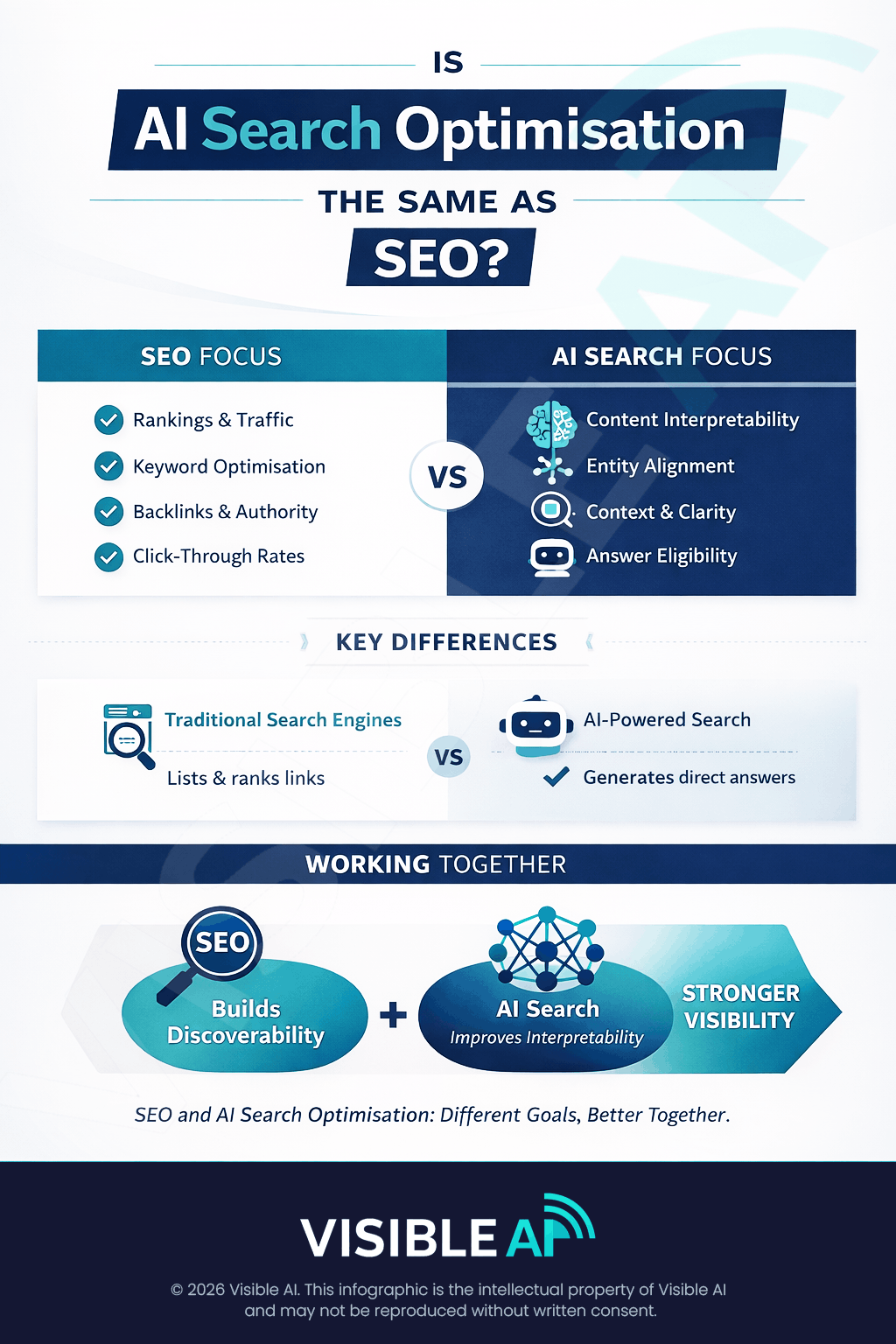
To embed this infographic, copy the code below and paste it into an HTML block on your website.
					<a href="https://visibleai.au/learn-ai-search/what-is-ai-search-optimisation/is-ai-search-optimisation-the-same-as-seo/">
  <img decoding="async" src="https://visibleai.au/wp-content/uploads/2026/02/seo-vs-ai-search-optimisation-infographic.png"
       alt="Is AI Search Optimisation the Same as SEO - Infographic by Visible AI"
       style="max-width:100%; height:auto;" />
</a>
<p style="font-size:14px; color:#6b7280;">
  Source: <a href="https://visibleai.au">Visible AI</a>
</p>
Share