
Home » Learn AI Search » What is AI Search Optimisation? » SEO vs Generative Engine Optimisation (GEO)
SEO vs Generative Engine Optimisation (GEO)

Search is changing, but it isn’t disappearing.
Traditional SEO has helped businesses rank in search engines for decades. Now, with the rise of AI-powered search tools and generative answers, a new term has entered the conversation: Generative Engine Optimisation (GEO).
Understanding the difference between SEO and GEO helps businesses make informed decisions about where to focus their efforts and why both matter.
What Is Traditional SEO?
Search Engine Optimisation (SEO) focuses on improving a website’s visibility in traditional search engines like Google.
SEO typically involves:
- Keyword research
- On-page optimisation
- Technical performance improvements
- Backlink development
- Content optimisation
- Improving rankings in search results
The objective of SEO is clear:
Increase rankings. Increase traffic. Increase visibility in search results.
SEO is primarily about positioning pages in response to specific keyword queries.
What Is Generative Engine Optimisation (GEO)?
Generative Engine Optimisation refers to preparing content and website structure so AI systems can interpret and reference it accurately when generating answers.
Instead of optimising for ranking positions, GEO focuses on:
- Clarity of service descriptions
- Logical website structure
- Clear entity definitions
- Question-aligned content
- Contextual relationships between pages
The objective of GEO is different:
Improve understanding so AI systems can confidently interpret and summarise your content.
GEO is less about placement and more about interpretation.
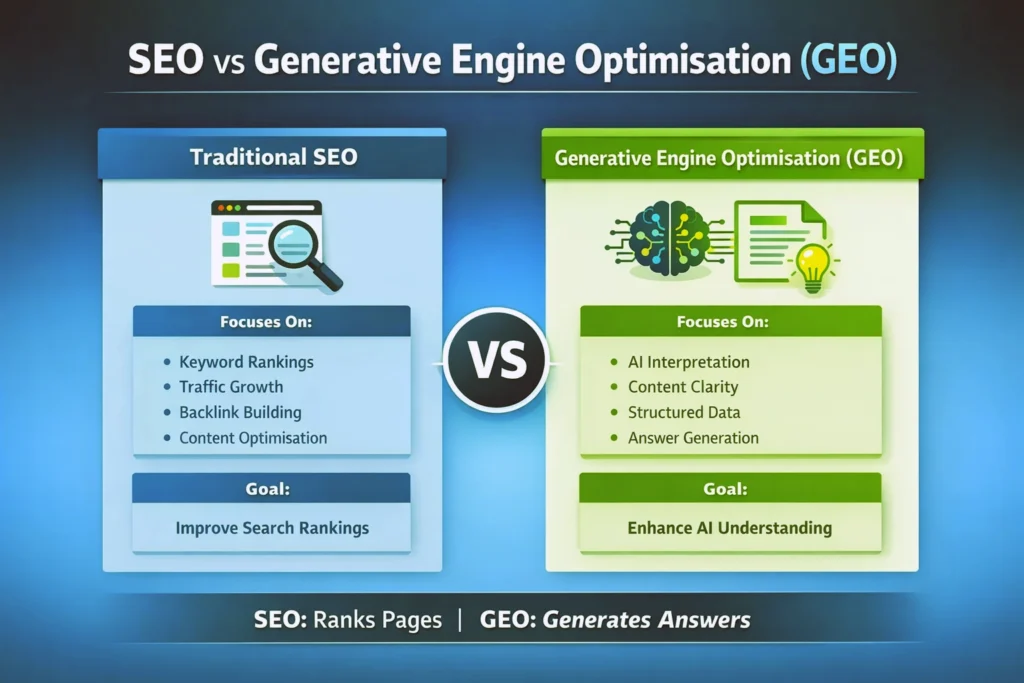
The Core Difference
SEO asks:
“How do we rank for this keyword?”
GEO asks:
“Does AI clearly understand what this business does and when it is relevant?”
That distinction changes the optimisation approach.
How Traditional SEO Works
Traditional search engines:
- Crawl websites
- Index content
- Rank pages based on relevance and authority
- Display results as clickable links
Users then choose which link to click.
Ranking position heavily influences visibility.
How Generative AI Systems Work
Generative AI systems:
- Interpret a user’s question
- Analyse relevant information
- Generate a structured response
- Summarise insights within the interface
Instead of simply listing links, AI systems attempt to provide answers directly.
This reduces reliance on ranking alone.
Does GEO Replace SEO?
No. SEO and GEO serve different roles.
SEO remains important because:
- Search engines still rank pages
- Many users still click links
- Traffic still matters
GEO becomes important because:
- AI-generated summaries are increasing
- Users ask conversational questions
- Visibility now includes being interpreted correctly
Rather than replacing SEO, GEO expands optimisation into a new layer.
- SEO drives visibility.
- Clarity supports interpretation.
Together, they strengthen performance.
Where SEO Still Dominates
SEO remains critical for:
- Competitive transactional keywords
- E-commerce product searches
- Local service searches
- High-volume commercial terms
Ranking still drives significant traffic. Ignoring SEO would be short-sighted.
Where GEO Becomes Important
GEO becomes especially relevant for:
- Informational queries
- Service comparison queries
- Educational searches
- Conversational, question-based searches
When users ask:
“What is AI search optimisation?”
“Who offers this service?”
“How does this work?”
AI systems may generate summarised answers rather than displaying only links.
Clear structure and context matter here.
Why Structure Matters More in GEO
Generative AI systems rely heavily on clarity.
This includes:
- Defined service pages
- Logical hierarchy
- Clear headings
- Consistent terminology
- Strong entity alignment
If a website is vague or poorly organised, AI systems may struggle to interpret it confidently.
SEO can sometimes tolerate ambiguity. GEO cannot.
What Businesses Should Focus On
Businesses do not need to choose between SEO and GEO.
A balanced approach often includes:
- Maintaining strong SEO fundamentals
- Improving structural clarity
- Strengthening entity signals
- Creating question-aligned content
- Reducing ambiguity in service descriptions
SEO attracts traffic. GEO strengthens interpretation. Together, they create resilience.
Is GEO Just a New Buzzword?
The terminology may evolve.
Some refer to it as:
- Generative Engine Optimisation
- Answer Engine Optimisation
- AI Search Optimisation
- AIGEO
The label matters less than the principle.
The underlying shift is real: Search engines are generating answers, not just ranking pages.
Businesses that adapt to this change are better positioned long term.
The Bigger Picture
Search is becoming more conversational and contextual.
Users increasingly expect:
- Direct answers
- Clear comparisons
- Structured explanations
Generative AI systems are designed to meet those expectations.
Optimisation is expanding from “ranking for keywords” to “being clearly understood.”
Final Thoughts
SEO remains foundational. Generative Engine Optimisation reflects how search is evolving.
Rather than competing concepts, they represent two layers of visibility:
- SEO improves ranking.
- GEO improves interpretation.
Businesses that invest in both clarity and discoverability are better prepared for the future of search.
FAQs – SEO vs GEO
Is Generative Engine Optimisation replacing SEO?
No. Generative Engine Optimisation does not replace SEO.
Traditional SEO focuses on improving rankings and driving traffic from search engines, while GEO focuses on helping AI systems interpret and summarise content accurately.
Most businesses benefit from combining both approaches rather than choosing one over the other.
What is the main difference between SEO and GEO?
SEO is primarily about ranking pages for specific keywords. GEO is about improving how AI systems understand, interpret, and generate responses using your content.
SEO focuses on placement in search results, while GEO focuses on clarity and contextual understanding.
Do I need to stop doing SEO if I invest in GEO?
No. SEO remains foundational for visibility. GEO builds on that foundation by improving structural clarity and interpretability for AI-powered search tools.
In most cases, SEO and GEO work best together.
Can a website rank well in Google but still perform poorly in AI search?
Yes. A website may rank highly in traditional search results but still lack the clarity or structure required for AI systems to interpret it confidently.
Generative AI systems rely heavily on context, hierarchy, and clearly defined services.
Is GEO only relevant for AI tools like ChatGPT?
No. GEO applies to any AI-powered system that generates answers rather than simply listing links.
This includes AI-enhanced search engines and conversational interfaces. The underlying principle is improving clarity and structured understanding
Does Generative Engine Optimisation guarantee visibility in AI answers?
No legitimate optimisation strategy can guarantee AI-generated mentions.
GEO improves the likelihood of being interpreted accurately by strengthening structure, clarity, and entity alignment, but final outputs depend on the user’s query and context.
What types of businesses benefit most from GEO?
Service-based and knowledge-driven businesses often benefit significantly because AI systems frequently summarise services, explain processes, and compare options.
Clear structure and defined service pages are especially important in these industries.
Is GEO just a new name for SEO?
Not exactly. While GEO overlaps with SEO in some areas, it focuses specifically on how AI systems generate answers rather than how search engines rank pages. The terminology may evolve, but the underlying shift toward AI interpretation is real.
Share